




While other states banned artificial intelligence in schools, South Australia built its own safe, home-grown system – and now the rest of the country is following its lead.
While other states banned AI in schools, South Australia built its own – and now the rest of the country is catching up.
The Department for Education partnered with Microsoft to design EdChat – a purpose-built chatbot that helps students learn and teachers teach, all within strict data and safety guardrails.
After a two-year trial involving more than 10,000 students, it’s now being introduced for all public secondary school students across the state.
And since the trial began, other states including Queensland, WA and NSW have launched their own programs, inspired by South Australia’s lead.

Inside the classroom
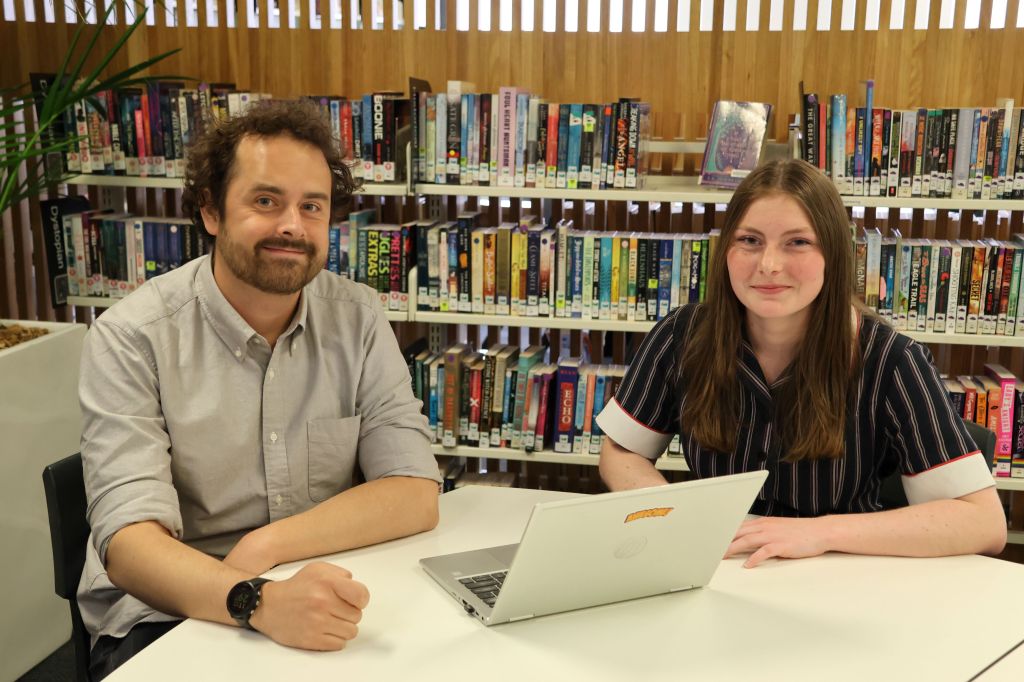
At Roma Mitchell Secondary College, Director of Curriculum (Humanities) Aladdin Watson has seen firsthand how AI can enhance everyday learning.
“We’ve been very lucky to have EdChat,” he says. “I know a lot of schools are only now just getting it so we’re a bit ahead of the game – which is nice.”
For teachers juggling full workloads, EdChat is proving a lifeline when it comes to lesson planning and classroom prep.
“I teach English and Humanities, which are often quite text-heavy subjects,” Aladdin says. “As part of our teaching practice, we’re often required to produce model responses to guide student learning. In the past, I would create these examples myself. Now I can utilise EdChat to help generate high-quality model responses, incorporating my own guidance and context into what it produces.”
The biggest win? More time to focus on students.
“I can differentiate content a lot more efficiently to students, which means I can better accommodate their learning needs in class. That’s been helpful in allowing me to meet my students where they’re at.”
Help at your fingertips
For Year 12 student Skye, EdChat is like having an extra tutor that’s always on call.
“If I’m on a bit of a time crunch, and I don’t have the time to wait for someone to reply to my question or email, I can just quickly ask EdChat and I have the answer right there in front of me,” she says.
She uses it across multiple subjects. “For English or Society and Culture, I can use it to create questions for assignments… In other subjects, like Biology or Mathematics, if I don’t understand a concept, I will ask EdChat to explain it to me in simpler terms.”
“It does help my educational experience because, if I’m stuck on an idea, I can get EdChat to help me generate more ideas to keep the flow going,” Skye says.
That accessibility, says Aladdin, is one of EdChat’s biggest advantages. “The reality is, as hard as we try, teachers only have limited face-to-face time with students. EdChat acts like a 24/7 tutor – it doesn’t replace teachers, but it extends the learning opportunities for students.”

Learning when to use it – and when not to
Instead of banning AI or pretending it doesn’t exist, South Australian schools are teaching students how to use it responsibly.
At Roma Mitchell, that’s meant introducing a red, yellow and green “traffic light” system to guide students on when and how AI is appropriate.
“It gives students an indication of when it is OK to use EdChat,” Aladdin explains. “If it’s a green traffic light, you can use AI in specific ways like text and idea creation. If it’s yellow, AI can be used in limited ways like understanding or generating ideas – but if it’s red, it definitely can’t be used at all.”
“The realisation is that [AI chatbots] are a tool and not a complete outsourcing of our abilities as professionals and as people,” Aladdin says. “We’re also looking at prompt engineering – how to create an effective input into these AI systems to optimise the output. So looking at how you ask good questions has been a big area of focus and a learning curve for us as educators.”
And sometimes, he adds, the best way to learn is to experiment. “It sounds weird but just going, ‘Oh, maybe I’ll use it here; maybe I’ll have a go there’,” he says. “Having those people who are able to push these technologies and show different ways they might use them, I think that’s really effective. In many ways, AI has encouraged a lot of collaboration and sharing of ideas.”

AI beyond the classroom
EdChat is just one part of SA’s bigger AI story.
To help people across the state understand and use the technology safely, TAFE SA has launched a new free short course, AI Essentials: Getting Started with Artificial Intelligence.
The fully online micro-credential takes around five to ten hours and covers what AI is, how it works, and how to use it ethically at work or home.
It’s open to anyone who wants to build their confidence with the technology shaping modern workplaces – from students just starting out to professionals looking to future-proof their skills.
SA is leading the way in harnessing the power of AI – not to replace people, but to support them. From classrooms to careers, it’s about giving South Australians the tools to thrive in a world where AI works for us, not instead of us.
Find out more about EdChat and its use in South Australian schools here.